

April 6
96/269


On This Day…
1320 — The Declaration of Arbroath Is Signed
On April 6, 1320, the barons and nobles of Scotland put their seals to a letter addressed to Pope John XXII — a diplomatic masterstroke written in Latin at Arbroath Abbey. It wasn’t a treaty. It wasn’t a law. It was a letter. But inside that letter was one of the most radical ideas the medieval world had ever seen: that a king derives his legitimacy from the consent of those he governs, and if he betrays that trust, the people have the right to replace him. The most famous passage declared, “It is in truth not for glory, nor riches, nor honours that we are fighting, but for freedom alone, which no honest man gives up but with life itself.”
The Declaration was a direct response to Pope John XXII’s refusal to recognize Robert the Bruce as Scotland’s lawful king after Edward I of England had used a succession crisis to assert English overlordship over Scotland. Robert had been excommunicated for disobeying a papal demand for a truce, and the Scottish nobility needed a way to fight back — diplomatically, not just on the battlefield. The barons were, in essence, lobbying the most powerful authority on earth with the most powerful argument available: the people of Scotland had chosen their king, and no foreign power had the right to override that.
The Arbroath declaration still echoes in a world where questions of sovereignty, self-determination, and the right of people to choose their own governments remain deeply contested. The Scottish National Party regularly invokes it in the context of Scottish independence from the United Kingdom — a debate that Brexit reignited with fury. Medieval diplomatic documents don’t typically stay politically alive for 706 years, but this one does, because the question it posed — who decides who governs you? — never goes away.
1453 — Mehmed II Begins the Siege of Constantinople
On April 6, 1453, Ottoman Sultan Mehmed II — just 21 years old — launched his artillery assault on the great Theodosian walls of Constantinople, beginning what would become a 57-day siege. He came with an army estimated between 80,000 and 200,000 men, a naval force of 320 vessels, and something the Byzantine defenders had never faced before: massive siege cannons capable of battering the ancient walls the city had relied upon for a thousand years. The Byzantine Emperor Constantine XI could muster only around 7,000 defenders against this juggernaut.
The city held for nearly two months. It fell on May 29. With it went the last remnant of the Roman Empire — a civilization that had stretched unbroken from Augustus Caesar to Constantine XI, over fifteen centuries. Mehmed moved his capital from Adrianople to Constantinople, renamed it Istanbul, and the Ottoman Empire spent the following century expanding rapidly into Europe, North Africa, and the Middle East. The fall simultaneously triggered a westward migration of Greek scholars whose knowledge would help fuel the European Renaissance.
The siege of Constantinople is still invoked today in debates about civilizational conflict, the limits of walls as defense, and the weight of what’s lost when ancient institutions crumble. The fractures it created between the Christian West and the Ottoman East shaped centuries of conflict — Crusades, proxy wars, the Eastern Question — and echoes in today’s tension between NATO’s eastern flank and Turkey’s complicated role within the alliance. Power vacuums don’t stay empty for long, and the fall of the last Roman stronghold is still history’s sharpest lesson in what happens when a weakened empire meets a hungry one.
1862 — The Battle of Shiloh Begins
On the morning of April 6, 1862, Confederate General Albert Sidney Johnston launched a surprise attack on Ulysses S. Grant’s Union forces camped at Pittsburg Landing in southwestern Tennessee. Grant’s men hadn’t fortified their camps — they were waiting for reinforcements, not an assault. The Confederates swept through the Union line, and by nightfall the battle had produced carnage that stunned the nation. The two-day engagement resulted in roughly 13,000 Union casualties and nearly 11,000 Confederate casualties.
Johnston was mortally wounded on that first afternoon, bleeding to death from a bullet to the leg. The tide turned the next day when Union reinforcements arrived and Grant launched a counterattack, forcing the Confederates back to Corinth, Mississippi. Grant came under heavy criticism afterward, with calls to relieve him of command. President Lincoln, famously, refused. “I can’t spare this man — he fights,” Lincoln reportedly said. That decision to back Grant kept in place the general who would eventually end the war.
Shiloh shattered the romantic illusions both sides had carried into the war. After April 6, 1862, nobody was talking about a short, glorious conflict. The willingness to absorb catastrophic losses and press forward anyway became the defining characteristic of Grant’s generalship — and a model for modern commanders who understand that in long wars, resolve and resupply matter more than a single brilliant maneuver. In an era when political leaders routinely fire military commanders after setbacks, Lincoln’s choice to keep Grant is a reminder that the most consequential executive decisions often happen quietly, in the face of public pressure to do otherwise.
1896 — The First Modern Olympic Games Open in Athens
On April 6, 1896, King George I of Greece officially opened the Games of the First Olympiad at the Panathenaic Stadium in Athens, before a crowd estimated at 80,000 — the largest ever assembled to watch a sporting event at the time. The date was chosen deliberately to coincide with Easter Monday and the anniversary of Greek independence. Pierre de Coubertin, the French aristocrat who founded the International Olympic Committee, had been working toward this moment for years, driven by the conviction that international athletic competition could serve as a force for peace and goodwill among nations. Athletes from 14 nations competed in 43 events; the United States won the most gold medals, while Greece took the most medals overall.
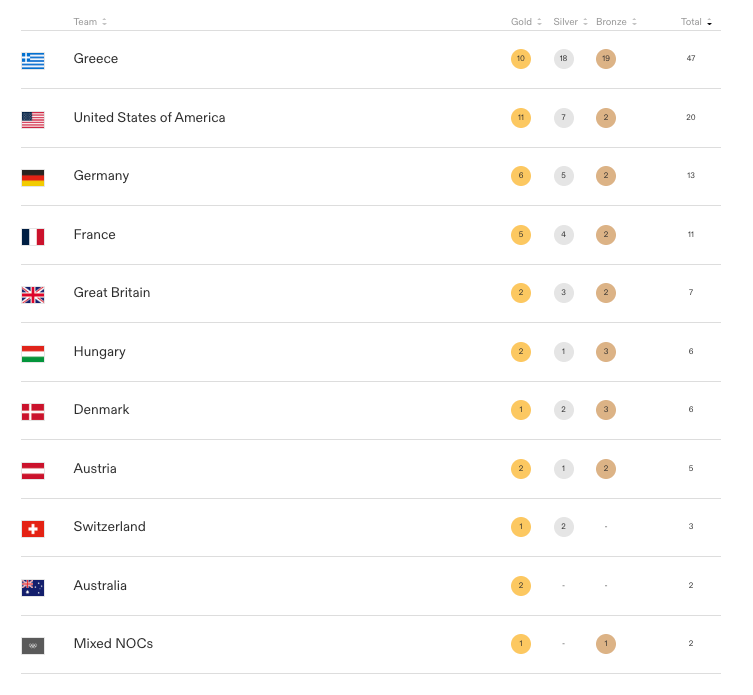
On that very first day, American triple-jumper James Connolly became the first Olympic champion in over 1,500 years, earning his place in history by winning the first event contested at the modern Games. The Greeks were electrified by their hometown hero Spyridon Louis winning the marathon — a race whose distance traced the route of the ancient Greek messenger who ran from Marathon to Athens to announce the victory over Persia. The games were considered a triumph, and the modern Olympic movement was born.
More than 200 nations now compete in the Summer Olympics, and the Games have become one of the most watched events in human history — as well as one of the most politically charged. From Jesse Owens in Berlin to the Black Power salute in Mexico City to the 1980 and 1984 boycotts, the Olympics has never escaped politics, despite Coubertin’s vision. What Athens proved on April 6, 1896 is that the hunger for shared spectacle and international competition is real and powerful — the problem is that nations rarely leave their politics at the door.
1917 — The United States Declares War on Germany
On April 6, 1917, President Woodrow Wilson signed the congressional resolution declaring war on Imperial Germany, ending nearly three years of American neutrality and formally entering the United States into the First World War. The House had passed the measure 373–50 just hours before; the Senate had voted 82–6 two days earlier. What finally pushed Wilson off the fence was a combination of Germany’s resumption of unrestricted submarine warfare — which threatened American ships and lives in the Atlantic — and the explosive revelation of the Zimmermann Telegram, in which Germany secretly proposed that Mexico attack the United States in exchange for Texas, New Mexico, and Arizona.
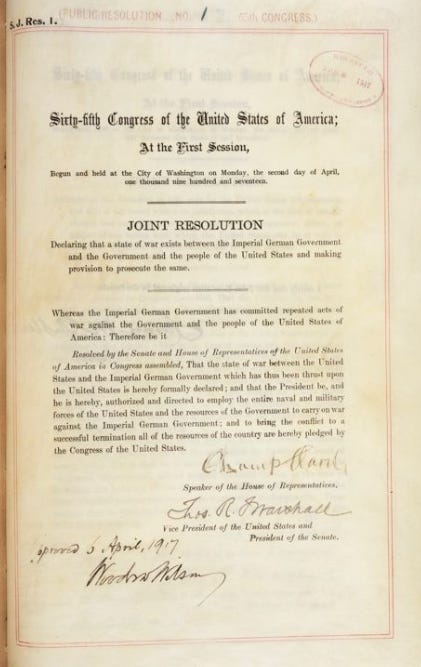
Wilson had campaigned for re-election in 1916 on the slogan “He kept us out of war.” He agonized over the decision, fearing — correctly — that entering the war would inflame domestic divisions and undo progressive domestic reforms. But he ultimately framed the declaration not as aggression but as moral obligation, famously declaring the goal was to “make the world safe for democracy.” American troops, industrial capacity, and fresh resources helped tip the balance for the Allies, and Germany surrendered in November 1918. The war’s aftermath — a punishing peace, economic collapse, and rising nationalism — laid the groundwork for the Second World War.
Wilson’s declaration on April 6 marked the moment the United States stopped being a spectator in global affairs and became an actor — and that shift has never been reversed. The debate Wilson had with himself in 1917 about whether entanglement in foreign conflicts serves American interests or bleeds American strength is a debate the country is still having in 2026, in the context of Ukraine, Taiwan, and NATO commitments. When a great power steps onto the world stage, it rarely steps back off — and the speech Wilson gave still frames how American presidents justify intervention to a skeptical public.
1930 — Gandhi Ends the Salt March
On April 6, 1930, after 24 days of walking 240 miles from his Sabarmati Ashram to the coastal village of Dandi in Gujarat, Mahatma Gandhi bent down, scooped up a lump of salt-crusted mud from the seashore, and broke the British salt law. It was 8:30 in the morning. With that single gesture, he sparked one of the largest acts of mass civil disobedience in history. Millions of Indians followed his example, defying the British salt monopoly — which taxed a basic necessity of life — and hundreds of thousands were eventually arrested, including Gandhi himself.
The march began with 78 volunteers and ended with a nation. The genius of the Salt March was its simplicity: Gandhi didn’t ask Indians to pick up arms, storm a government building, or overthrow anything. He asked them to make salt. It was a physical act anyone could perform, a law anyone could break, and a grievance everyone understood. The international press covered it intensely, transmitting images of peaceful marchers being beaten by police to newspaper readers around the world — and the moral contrast did more damage to British imperial legitimacy than any military campaign could have.
The Salt March remains the gold standard of strategic nonviolent direct action, studied by every civil rights movement that followed — from the American civil rights movement of the 1950s and 60s to pro-democracy demonstrators in Hong Kong and Iran. The lesson Gandhi encoded that morning in Dandi is that the most durable revolutions are the ones that make the powerful look brutish and the powerless look dignified. In a world where authoritarian governments are again cracking down on peaceful protest, the question Gandhi’s march poses is as sharp as ever: what happens when the cost of obedience becomes greater than the cost of resistance?
1974 — ABBA Wins Eurovision with “Waterloo”
On April 6, 1974, four Swedes in some of the most gloriously over-the-top costumes ever assembled stormed the stage at The Dome in Brighton, England, and performed a song called “Waterloo” before a continent-wide television audience. ABBA — Agnetha, Björn, Benny, and Anni-Frid — scored 24 points to win the 19th Eurovision Song Contest, Sweden’s first-ever Eurovision victory. Nobody in the room that night could have predicted that they were watching the birth of one of the best-selling music acts in history, a group that would eventually move more than 400 million records worldwide and whose music would inspire a stage musical, two films, and a permanent museum in Stockholm.
“Waterloo” was a deliberate reinvention. After failing to qualify for Eurovision in 1973 with the Swedish-language “Ring Ring,” ABBA went back to the drawing board and crafted something that fused glam rock energy with irresistible pop melody and a dash of historical wit — the narrator surrenders to love the way Napoleon surrendered at Waterloo. The performance was unlike anything Eurovision had seen before: the glitter, the physicality, the sheer joy of it. It broke through the polite ballads and tidy folk songs that dominated the contest and announced that pop music could be theatrical, big, and unashamedly fun.
Eurovision itself has become one of the most geopolitically fascinating cultural events in the world — a competition that now reflects European alliances, tensions, and identities as clearly as any diplomatic summit. Countries vote strategically. Diaspora communities mobilize. Ukraine’s 2022 victory became an act of political solidarity. What ABBA did on April 6, 1974, wasn’t just launch a pop career — they demonstrated that a small country with no military power and limited global reach could capture the world’s attention through sheer creative force. In an era when soft power matters more than ever, that’s not a small thing.
1994 — The Rwandan Genocide Begins
On the evening of April 6, 1994, a surface-to-air missile shot down the plane carrying Rwandan President Juvénal Habyarimana and Burundian President Cyprien Ntaryamira as it prepared to land in Kigali. All 12 people aboard were killed. Within hours, Rwandan Army and Interahamwe militia roadblocks went up across the country. The radio station RTLM — which had spent months calling Tutsis “inyenzi,” cockroaches — broadcast instructions to kill. It remains unclear to this day who fired the missile, but what happened next is devastatingly clear: in the following 100 days, an estimated 800,000 to one million Tutsi and moderate Hutu were systematically slaughtered.
The international community knew what was happening and did next to nothing. The United States, still stung by the Black Hawk Down disaster in Somalia, explicitly avoided using the word “genocide” — because the 1948 Genocide Convention would have required action. The UN had peacekeeping forces in Rwanda; their commander, Canadian General Roméo Dallaire, sent a famous “genocide fax” to UN headquarters in January 1994 warning of the planned extermination campaign. He was told to stand down and not to act on the intelligence. Ten Belgian peacekeepers were tortured and murdered in the opening days; Belgium then withdrew its forces entirely.


Rwanda forced a reckoning with the fundamental question of international order: does sovereignty shield governments that are killing their own people? The genocide directly inspired the Responsibility to Protect doctrine adopted at the 2005 UN World Summit — the principle that the international community has an obligation to intervene when a state fails to protect its citizens from mass atrocities. But the doctrine has been applied selectively and inconsistently ever since, from Libya to Syria to Darfur. Thirty-two years later, as ethnic violence flares across multiple continents and great powers compete for influence rather than for accountability, April 6, 1994 stands as history’s most brutal answer to the question of what happens when the world decides that looking away is easier than acting.