

April 7
97/268


On This Day…
529 — Justinian I Issues the Corpus Juris Civilis
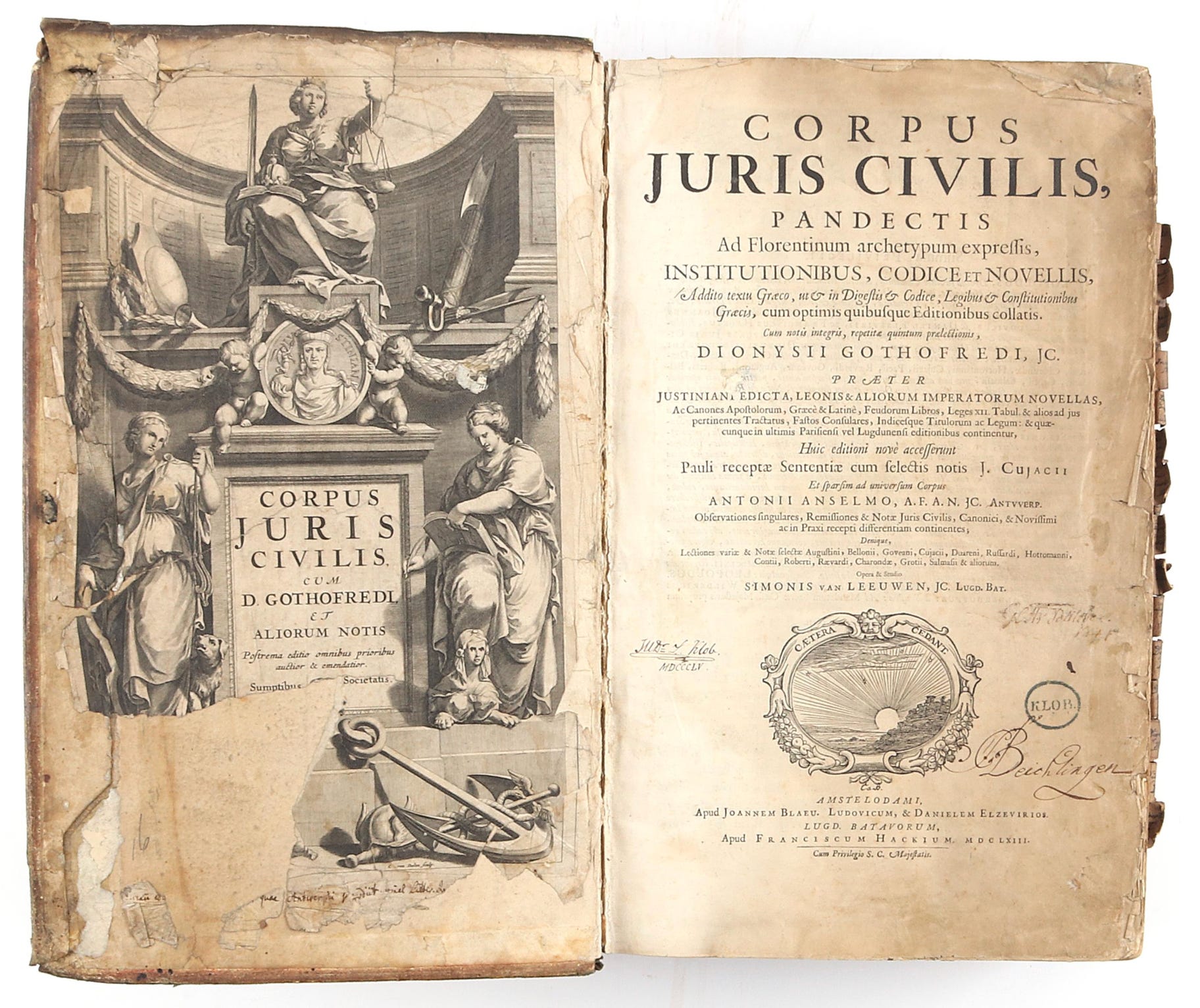
On April 7, 529 AD, the Eastern Roman Emperor Justinian I promulgated the first part of his Corpus Juris Civilis — the “Body of Civil Law” — a sweeping codification of Roman legal tradition assembled by a commission led by the jurist Tribonian. The Code consolidated centuries of imperial edicts and legal opinions into a single, authoritative document, superseding all previous legal records and sweeping away the contradictions that had plagued Roman jurisprudence for generations.
The Corpus Juris Civilis became the bedrock of Byzantine law for over 900 years and was rediscovered in Western Europe during the medieval period, directly shaping the legal systems of France, Spain, Germany, Italy, and virtually every nation in the civil law tradition.
The concept that law should be codified, accessible, and applied consistently — rather than left to the discretion of individual magistrates — is a principle that animates debates over judicial independence, Supreme Court interpretation, and due process protections to this day. Every time a court applies a statute rather than relying on a judge’s whim, Justinian’s April 7 gamble is still paying dividends.
1862 — The Union Counterattacks at the Battle of Shiloh
On April 7, 1862, Union General Ulysses S. Grant launched a devastating counterattack against Confederate forces near Shiloh Church in southwestern Tennessee, reversing a day of stunning Confederate gains and forcing General P.G.T. Beauregard’s army into a bloody retreat toward Corinth, Mississippi. The two-day battle — which began with a surprise Confederate assault on April 6 — produced roughly 23,000 casualties total, making it one of the bloodiest engagements of the entire war up to that point.
Shiloh shattered any remaining illusions on both sides that the Civil War would be short or clean. Grant, who had nearly been relieved of command after the first day’s chaos, was vindicated by his tenacious counterattack, cementing the relentless strategic style that would ultimately win the war. The battle’s legacy endures in the American military’s institutional belief — tested again in Korea, Vietnam, and Iraq — that tactical setbacks do not dictate strategic outcomes, and that a determined commander who holds his nerve through the first day of disaster can still turn the tide on the second.
1915 — Billie Holiday Is Born in Philadelphia
On April 7, 1915, Eleanora Fagan — better known to the world as Billie Holiday — was born in Philadelphia, Pennsylvania. Growing up in poverty in Baltimore and later Harlem, she found her way into jazz clubs as a teenager and was discovered at 18 by producer John Hammond, quickly recording with Benny Goodman and Count Basie and earning the nickname “Lady Day” from saxophonist Lester Young.
Holiday was far more than a singer — she was a cultural and political force whose 1939 performance of “Strange Fruit,” a searing account of Southern lynching, is now considered by many scholars one of the first protest songs of the Civil Rights Movement. Her willingness to use her voice against racism, at great personal and professional cost, prefigures every artist who has since used their platform to challenge injustice. At a moment when debates about art, protest, and social commentary continue to roil American culture, Holiday’s life is a reminder that music has always been one of the most powerful — and most dangerous — forms of political speech.
1927 — The First Long-Distance Television Demonstration
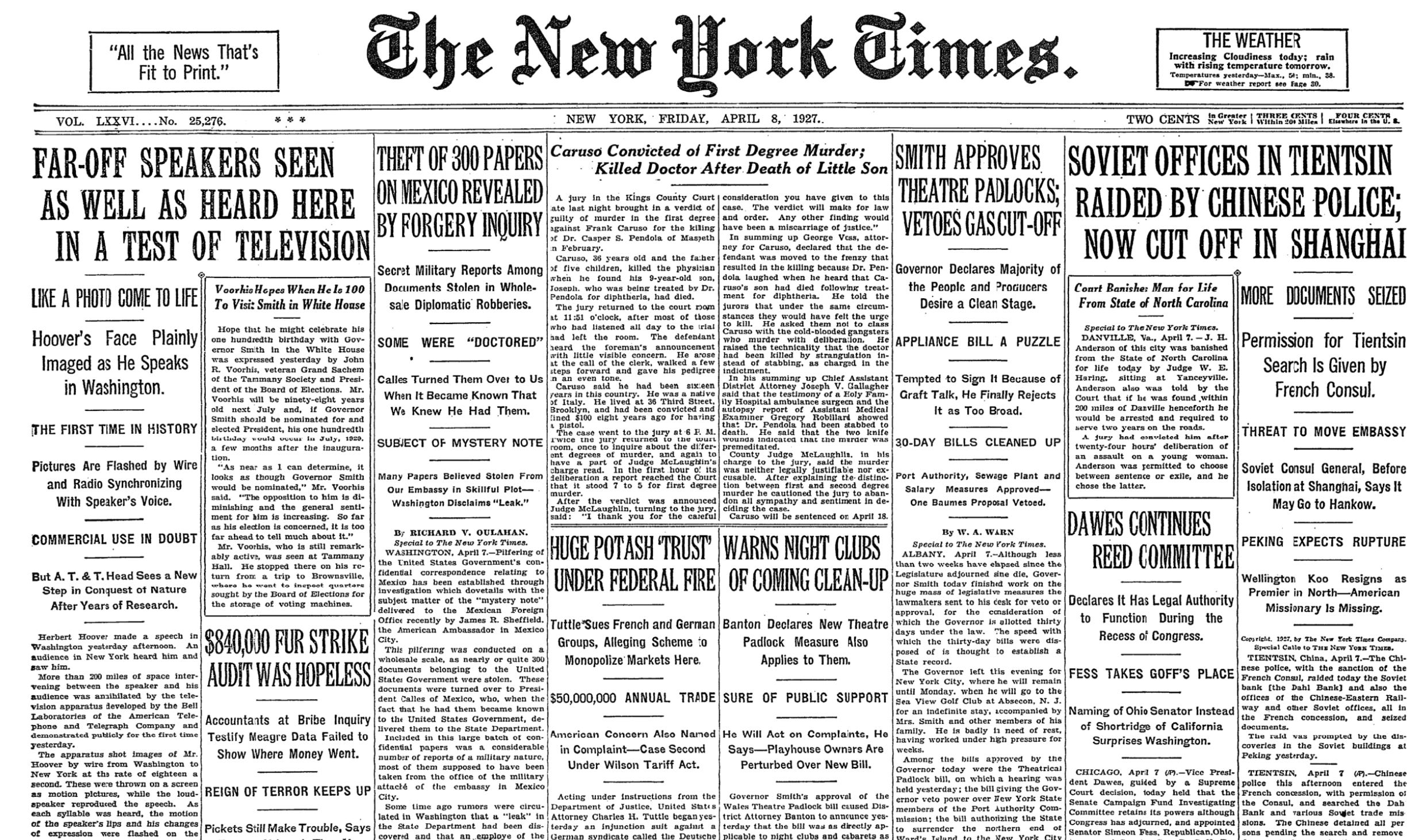
On April 7, 1927, reporters and officials gathered in a New York City auditorium at Bell Telephone Laboratories to witness the first American demonstration of long-distance television. The live image and voice of Commerce Secretary Herbert Hoover were transmitted over telephone lines more than 200 miles from Washington, D.C., to the midtown Manhattan crowd — Hoover declaring that “human genius has now destroyed the impediment of distance in a new respect”.
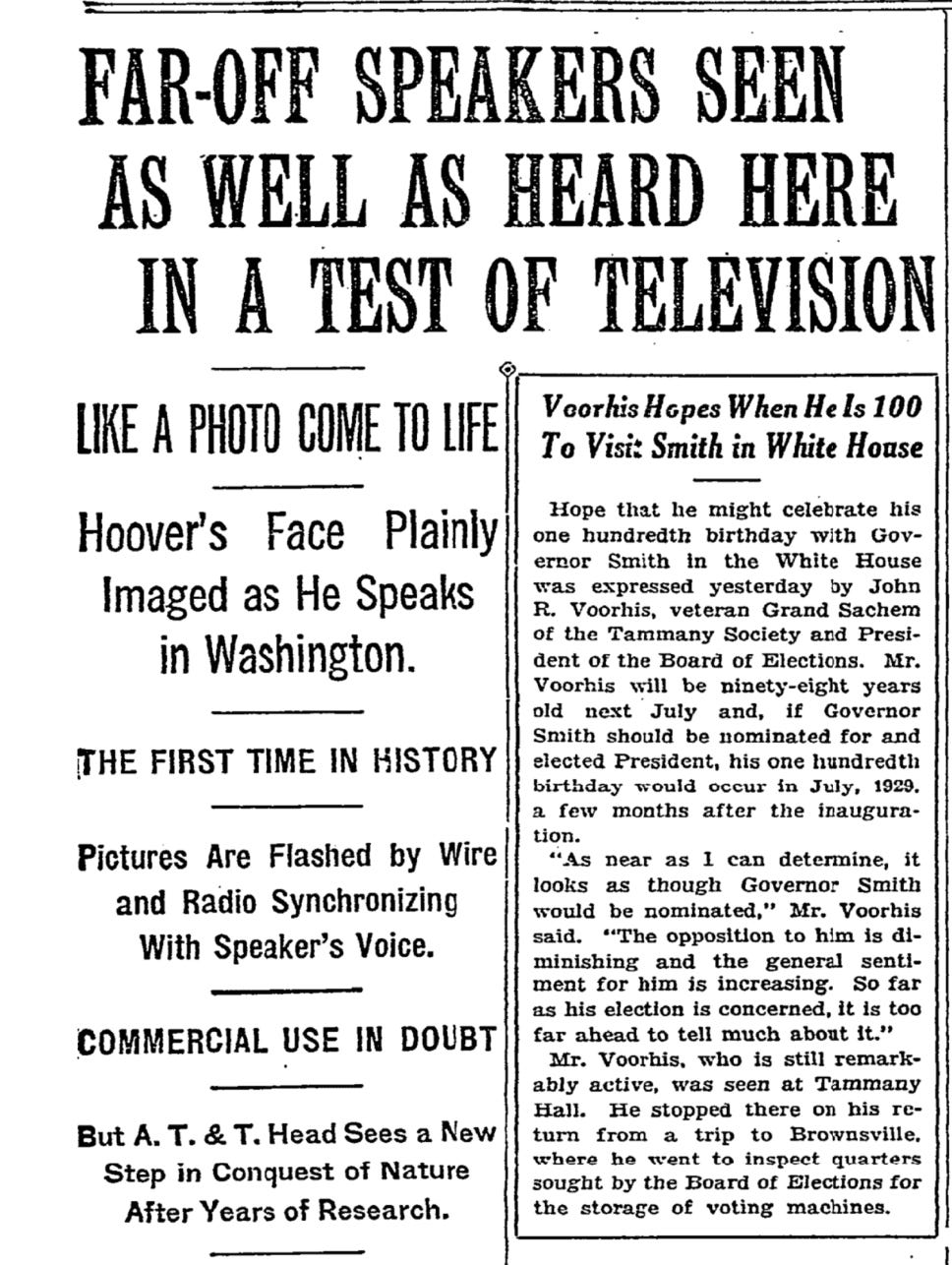
The demonstration was designed as a test of long-distance telephone networks, not as entertainment — and yet the New York Times ran it as a front-page story describing the transmission as “like a photo come to life,” while cautioning that “commercial use is in doubt”.
The underestimation of television’s social and political consequences would prove one of the great miscalculations in modern history. Today, as politicians craft their entire identities around cable news hits and social media video, the question of who controls the image — and the distance over which it can be projected — remains as contested as it was the day Hoover’s face flickered onto that 2×2.5-inch screen.
1939 — Italy Invades Albania
On April 7, 1939, Mussolini’s forces — some 100,000 troops supported by 600 aircraft — attacked all Albanian ports simultaneously, rapidly overwhelming King Zog I’s forces and forcing the monarch into exile within days. The invasion was Mussolini’s response to feeling upstaged by Hitler’s annexation of Czechoslovakia and his desire to demonstrate Italian imperial power in the Balkans, making Albania a fascist protectorate in personal union with the Italian crown.
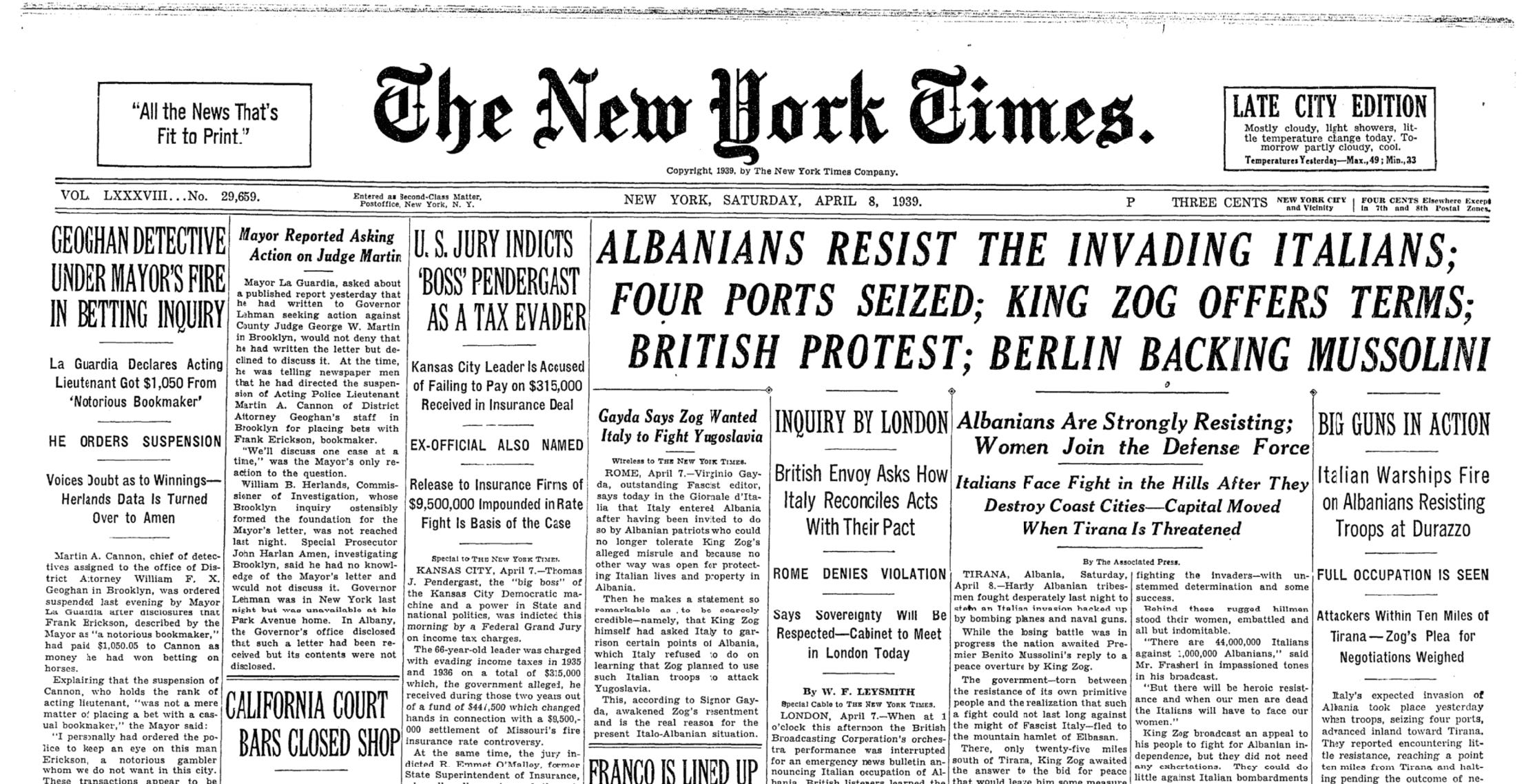
The seizure of Albania was a critical rehearsal for the broader catastrophe of World War II — a brazen act of aggression on Good Friday that drew only weak protests from Britain and France, who were exhausted from appeasing Hitler.
Winston Churchill warned at the time that even a few British ships could have deterred Mussolini, but the Western ruling class, as he later wrote, kept “taking its weekends in the country” while the dictators took their countries. The pattern of democratic powers failing to enforce consequences for incremental aggression — visible again in the years leading up to Russia’s invasion of Ukraine — is a lesson that this date wrote in blood.
1954 — Eisenhower Articulates the “Domino Theory”
On April 7, 1954, President Dwight D. Eisenhower held a press conference in which he articulated what became known as the “domino theory” — the idea that if South Vietnam fell to communism, the surrounding nations of Southeast Asia would topple in rapid succession, like a row of dominoes. France was already on the verge of catastrophic defeat at Dien Bien Phu, and Eisenhower framed the stakes in existential terms: the loss of Indochina, Burma, Thailand, Malaya, and Indonesia — threatening even Australia and New Zealand.
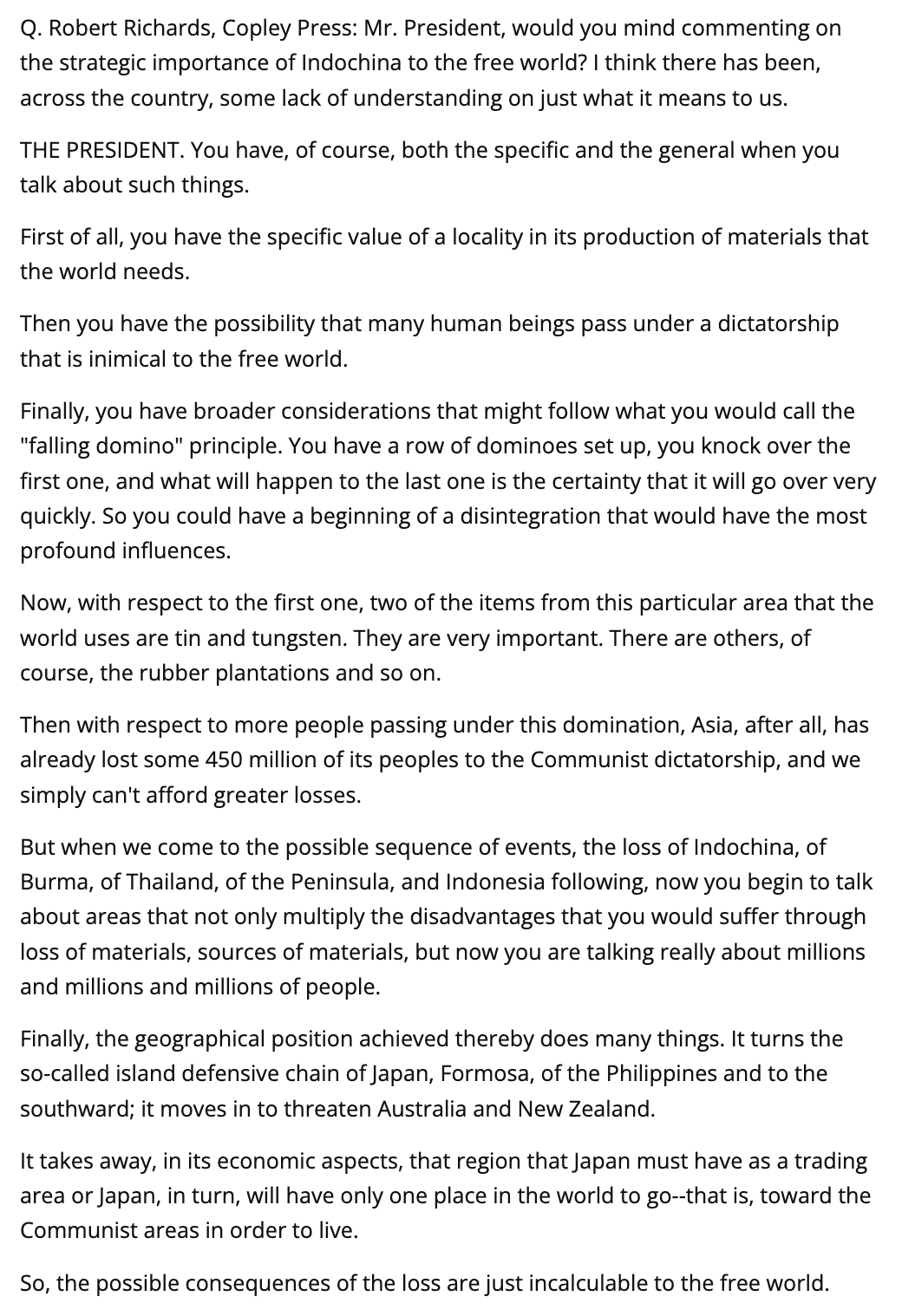
The theory dominated American foreign policy thinking for the next two decades. When the war was lost and the dominoes didn’t actually fall across Southeast Asia — with the exception of Laos and Cambodia — the theory was largely discredited, but its underlying impulse — to frame every regional conflict as an existential test of American resolve — never fully disappeared. From Iraq to Ukraine to Taiwan, American policymakers still grapple with Eisenhower’s question: when does standing aside invite an avalanche, and when does intervention make the situation worse?
1994 — Rwandan Prime Minister Agathe Uwilingiyimana Is Killed
On April 7, 1994, Hutu extremists launched what would become one of the worst genocides of the 20th century, murdering Rwandan Prime Minister Agathe Uwilingiyimana and ten Belgian UN peacekeepers who had been assigned to protect her — a signal that the international community would not act. Following the assassination of President Habyarimana the evening before, the Interahamwe militia erected roadblocks across Kigali and began systematically slaughtering Tutsi civilians, while the extremist radio station RTLM broadcast incitements to genocide, calling Tutsis “cockroaches” that must be exterminated.
Over the following 100 days, an estimated 800,000 to one million Rwandan Tutsi and moderate Hutu were murdered — while the world watched. UN peacekeeping commander Roméo Dallaire had sent a now-infamous “genocide fax” months earlier warning of the extermination plot, but the UN — under Kofi Annan’s oversight of peacekeeping operations — declined to act. The failure haunts international law and humanitarian intervention doctrine to this day: every subsequent debate about intervention in Darfur, Syria, or Myanmar circles back to the same haunting question of what the international community owes to civilians being systematically murdered by their own government, and whether “never again” is a promise or just a prayer.