

April 8
98/267


On This Day…
217 AD — The Assassination of Emperor Caracalla
On April 8, 217 AD, the Roman Emperor Caracalla was murdered on the roadside near Carrhae, Mesopotamia — stabbed by a soldier while he dismounted to relieve himself, on the orders of his own Praetorian prefect, Macrinus. It was an undignified end for an emperor who had terrorized Rome, murdered his own brother Geta in their mother’s arms, and ordered purges that some accounts estimate killed 20,000 people. Macrinus declared himself Emperor three days later.
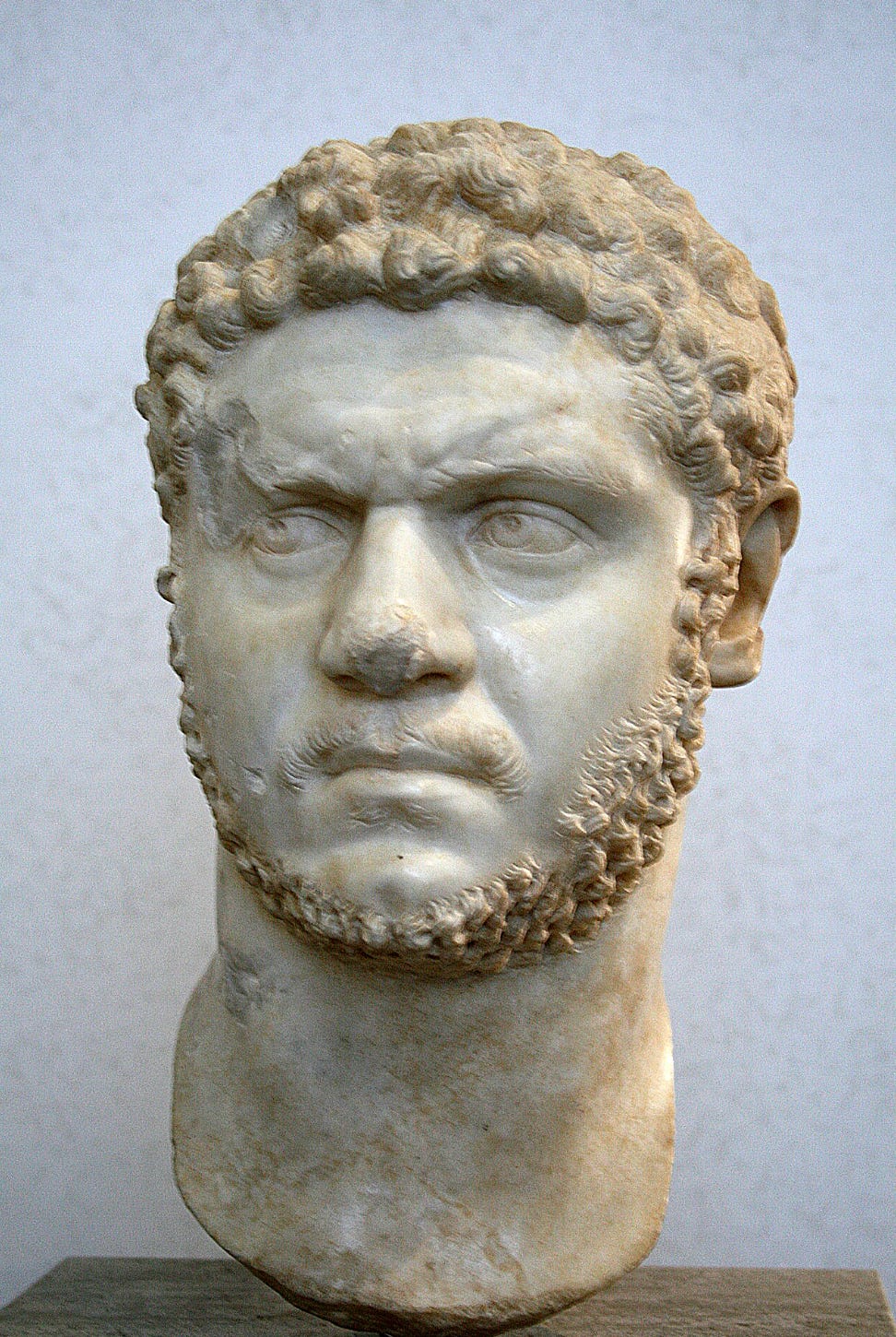
What history tends to bury beneath the blood is that just a year before his death, Caracalla had issued the Constitutio Antoniniana — extending Roman citizenship to all free inhabitants of the Empire, one of the most sweeping grants of civic membership the ancient world had ever seen. UNESCO has recognized the edict alongside the Magna Carta and the Declaration of the Rights of Man as a foundational document in the history of human rights.
The question of who belongs — and under what conditions a state decides to include or exclude — is as alive today as it was in 212 AD. Caracalla’s citizenship edict is a persistent reminder that transformative policy doesn’t require a virtuous leader, and that even cynical political acts (he likely needed the tax revenue from new citizens) can produce genuinely consequential outcomes. Powerful states have always weaponized citizenship — as reward, as leverage, as exclusion — and the arguments haven’t fundamentally changed.
1513 — Juan Ponce de León Claims Florida for Spain
On April 8, 1513, Spanish explorer Juan Ponce de León formally claimed Florida for the Spanish Crown, naming it La Florida after the Easter season, pascua florida, during which he arrived. Sailing from Puerto Rico with three ships, he planted a flag on behalf of an empire across land where indigenous peoples had lived for thousands of years. His first landing met swift resistance from the Calusa, who had likely already encountered Spanish slave raiders, and his second expedition in 1521 ended with Ponce de León fatally wounded by a Calusa arrow — driven off the land he’d claimed.
Florida is now the third most populous state in the country, a perennial electoral battleground, home to the largest Cuban diaspora in the world, and a cultural crossroads shaped by Spanish colonial roots that run directly back to that April 8 claim. Empires plant flags on other people’s land and call it discovery; the consequences ripple forward for centuries. The debates over immigration, identity, and sovereignty that define Florida politics today didn’t begin with cable news — they began on a beach more than five hundred years ago.
1864 — The U.S. Senate Passes the 13th Amendment
On April 8, 1864, before a packed Senate gallery in Washington, the United States Senate passed the 13th Amendment to the Constitution, abolishing slavery by a vote of 38 to 6. The coalition included 30 Republicans and four border-state and Union Democrats. It was a historic vote — but not yet a finished one. The House rejected the amendment in June, and it took Lincoln’s personal political maneuvering, a presidential election, and the grinding final months of the Civil War before ratification was completed in December 1865. Critically, the amendment retained a loophole: slavery was abolished “except as a punishment for crime” — language that would be exploited almost immediately through the convict leasing system.
The Senate’s April 8 vote signaled that the government was no longer merely fighting to preserve the Union but to fundamentally transform it. Constitutional change is never the end of the fight — it’s the starting gun. The formal abolition of slavery coexisted for nearly a century with legal racial terror, disenfranchisement, and debt labor. The exception clause is still litigated today in debates over prison labor and mass incarceration. What the 13th Amendment teaches is that legal language, however triumphant in the moment, only matters as much as the political will to enforce it.
1904 — Britain and France Sign the Entente Cordiale
On April 8, 1904, after centuries of rivalry and the near-collision of the 1898 Fashoda Incident, Britain and France signed the Entente Cordiale in London — a series of agreements settling colonial disputes across Egypt, Morocco, West Africa, Newfoundland, and Southeast Asia. It wasn’t a military alliance; it was something more durable: a mutual decision that two old adversaries had more to gain as partners than as competitors. King Edward VII’s personal affection for France and his diplomatic tour of Paris in 1903 helped smooth the way for what his foreign ministers then formalized.
Within a decade, the Entente had grown into the Triple Entente with Russia, and when the assassination at Sarajevo lit the fuse in 1914, the web of understandings forged on April 8, 1904 pulled Britain into World War I. The Entente Cordiale is the direct ancestor of NATO, the Anglo-French relationship, and the broader architecture of Western liberal alliance — all of which are under more pressure today than at any point since 1939. Solidarity between democracies has never been the natural order of things. It has always been a deliberate, difficult choice made by nations that knew what the alternative looked like.
1945 — Dietrich Bonhoeffer Is Sentenced to Death
On April 8, 1945, SS judge Otto Thorbeck convened a summary court-martial at Flossenbürg concentration camp and sentenced the Lutheran pastor and theologian Dietrich Bonhoeffer to death for treason — no witnesses, no formal defense, no written record. He was hanged at dawn the next morning. The Nazis had found Admiral Canaris’s diary days earlier, which detailed the Abwehr resistance network; Hitler personally ordered the executions. American forces would have reached Flossenbürg within weeks. Bonhoeffer had spent his final two years in prison writing some of the most consequential theological and political reflections of the 20th century, including the concept of “costly grace” — the idea that genuine faith demands real sacrifice, not just belief.
Bonhoeffer’s death sentence on April 8 asks a question that never gets easier: when a state demands silence, what does your conscience require? His life and death shaped liberation theology, animated the Civil Rights Movement, and became a touchstone for anyone wrestling with the proper relationship between faith and political resistance. In an era of rising authoritarianism across the globe, and intensifying debates about when institutions require not compliance but direct confrontation, Bonhoeffer’s legacy doesn’t sit quietly in a seminary library — it pushes back against the notion that good people can wait out evil without becoming complicit in it.
1973 — Pablo Picasso Dies at 91
On April 8, 1973, Pablo Picasso died of heart failure at his villa in Mougins, France, still painting until his final year — still producing raw, urgent work confronting mortality directly. He left behind more than 20,000 works across painting, sculpture, ceramics, and printmaking. His most radical contribution — Cubism, co-developed with Georges Braque — didn’t just transform fine art; it changed the visual grammar of advertising, film editing, and graphic design, embedding itself in the way modern culture processes space and perspective. His death was front-page news across Europe and the United States, and the market for his work has only grown since: a single painting sold for over $104 million at auction in 2004.
His death comes into sharper focus in the age of AI-generated art and algorithmic creativity. Picasso’s genius was synthesis and transformation — breaking everything apart and reassembling it in ways no one had seen. That is a deeply human act, born of a specific life, specific obsessions, and a lifetime of failure and reinvention. His legacy has also been reassessed in recent years for his exploitative relationships with women — a reminder that cultural greatness and personal harm are not mutually exclusive, and that the full accounting of a legacy eventually arrives whether we invite it or not.
1974 — Hank Aaron Hits Home Run #715
On April 8, 1974, before a crowd of 53,775 in Atlanta, Hank Aaron hit his 715th career home run off Dodgers pitcher Al Downing in the fourth inning, breaking Babe Ruth’s record that had stood for nearly four decades. His mother ran onto the field and grabbed him — Aaron later realized she wasn’t hugging him out of joy alone, but out of terror, finally released. In the months leading up to the record, Aaron had received nearly a million pieces of mail, much of it death threats and racist hate. He had a full-time bodyguard. The FBI was monitoring threats on his life. Vin Scully’s call has lived in the American memory ever since: “A Black man is getting a standing ovation in the Deep South for breaking a record of an all-time baseball idol. And it is a great moment for all of us.”


Aaron later said the experience had “chipped away at a part of my life I will never have again” — that he had never been able to simply enjoy breaking the record because of the hatred that surrounded it. Time magazine reflected after his death in 2021 that in the age of social media, the volume and viciousness would have been orders of magnitude worse. April 8, 1974 is a study in the price paid by those who achieve what this society was designed to prevent them from achieving. A standing ovation and a death threat are not opposites — sometimes they arrive in the same moment, in the same stadium, on the same night.