

April 9
99/266


On This Day…
1454 — The Treaty of Lodi Is Signed
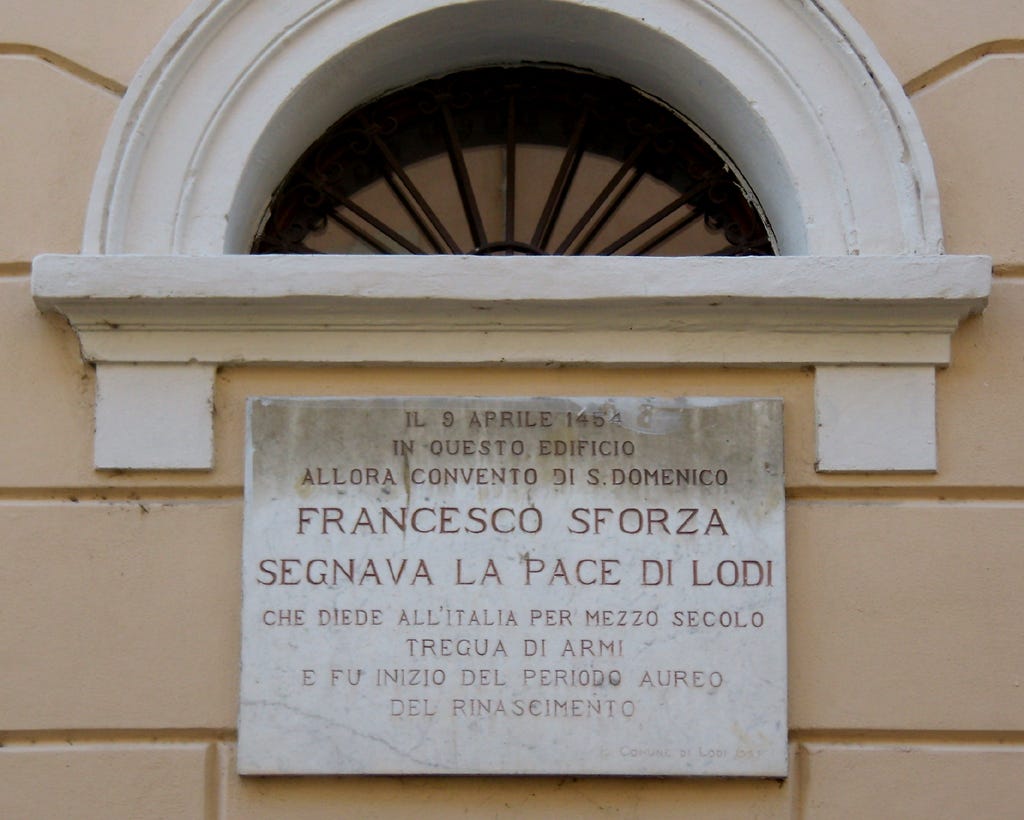
On April 9, 1454, the city-states of Venice, Milan, and Florence put their signatures on the Treaty of Lodi, ending years of destructive war across northern Italy and establishing a delicate balance of power that would hold for nearly half a century. Brokered at the Italian city of Lodi, the agreement drew in most of the major Italian powers and created an informal concert system — a precursor to the idea that rival states could manage their competition through diplomacy rather than constant warfare. It was, in its own quiet way, one of the earliest working models of collective security in Western political history.
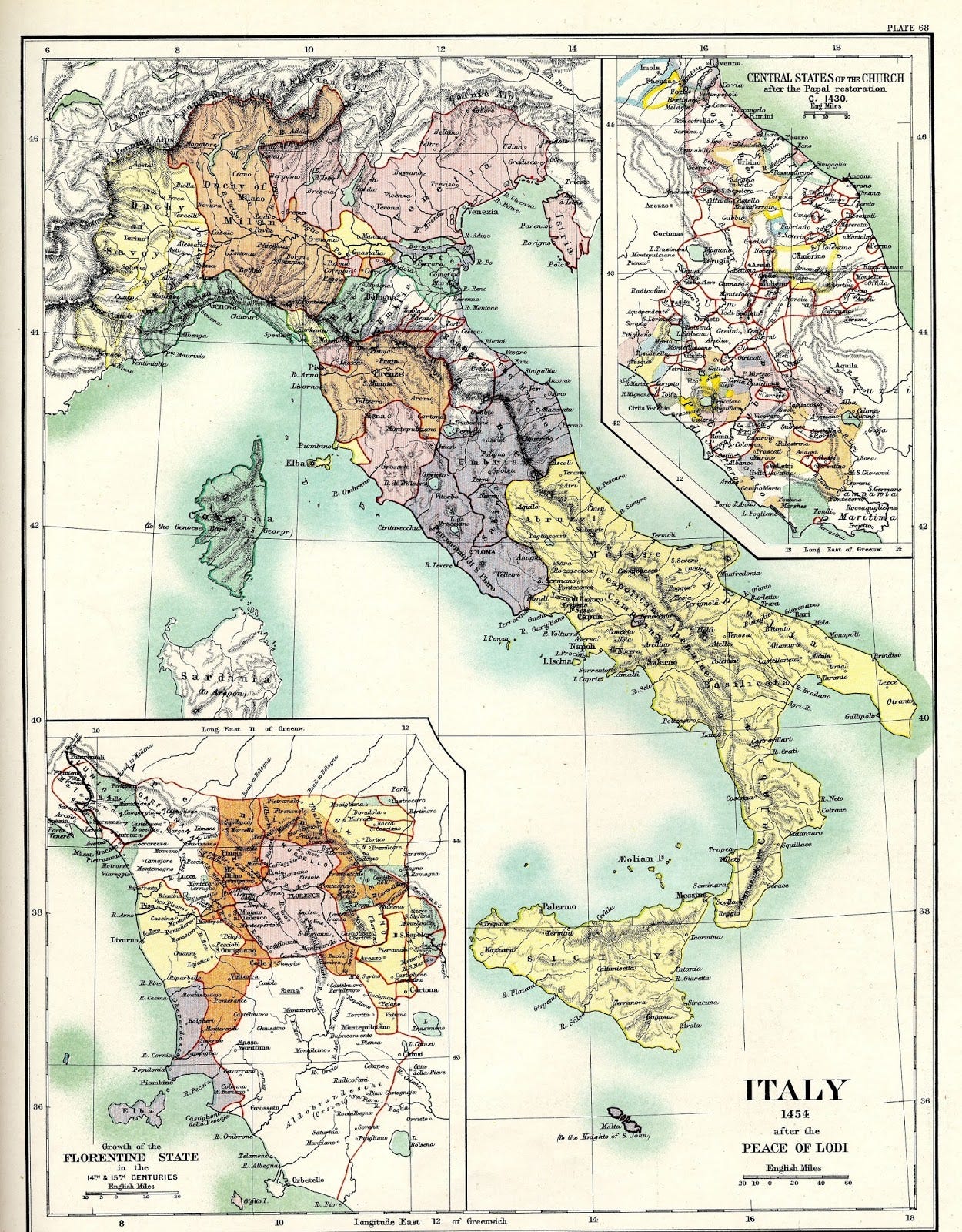
The treaty’s legacy lives in every modern multilateral agreement and alliance framework. The idea that rival powers can agree to manage tension — rather than constantly fight it out — is the logic behind NATO, the UN Security Council, and today’s diplomatic negotiations over Iran, Ukraine, and Taiwan. When those frameworks fray, as they are doing now, it’s worth remembering that the alternative the Italian city-states faced before 1454 was ruinous and exhausting war that benefited none of them.
1682 — La Salle Claims the Mississippi for France
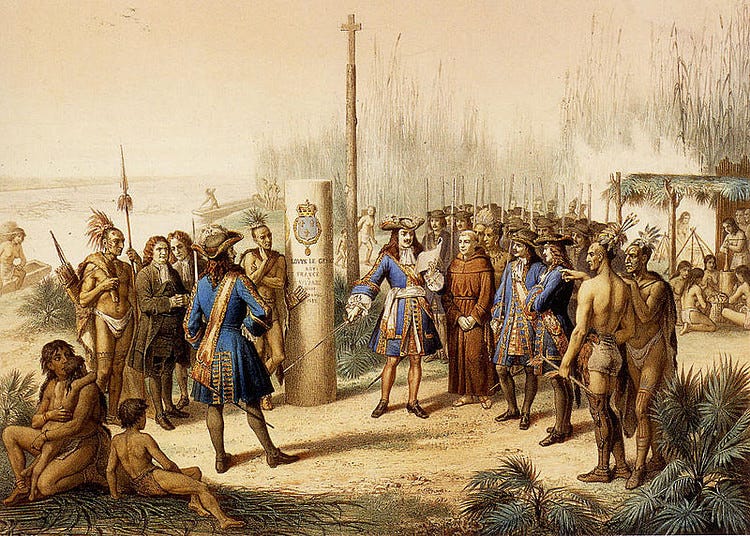
On April 9, 1682, the French explorer René-Robert Cavelier, Sieur de La Salle, reached the mouth of the Mississippi River, planted a cross and a column bearing the French coat of arms, and claimed the entire river basin for King Louis XIV — naming it Louisiana. In a single ceremony, La Salle staked France’s claim to an interior empire stretching from the Great Lakes to the Gulf of Mexico, encompassing what would eventually become the heart of the American continent. It was one of the most audacious land claims in the history of European colonialism, performed by a small expedition deep in territory already home to dozens of Native nations.
That claim would eventually become the Louisiana Purchase of 1803, the real estate deal that doubled the size of the United States and set the country on its path to continental dominance. The act of simply declaring sovereignty over land you don’t control — and having the world accept it over time — is a pattern that echoes in modern disputes over the South China Sea, Arctic territory, and contested Indigenous lands. Possession, as La Salle understood, is a performance as much as a fact.
1865 — Robert E. Lee Surrenders at Appomattox
On April 9, 1865, Confederate General Robert E. Lee — having exhausted every avenue of escape after the fall of Richmond and the nine-month Siege of Petersburg — rode to the parlor of Wilmer McLean’s home in Appomattox Court House, Virginia, and surrendered the Army of Northern Virginia to Union General Ulysses S. Grant.
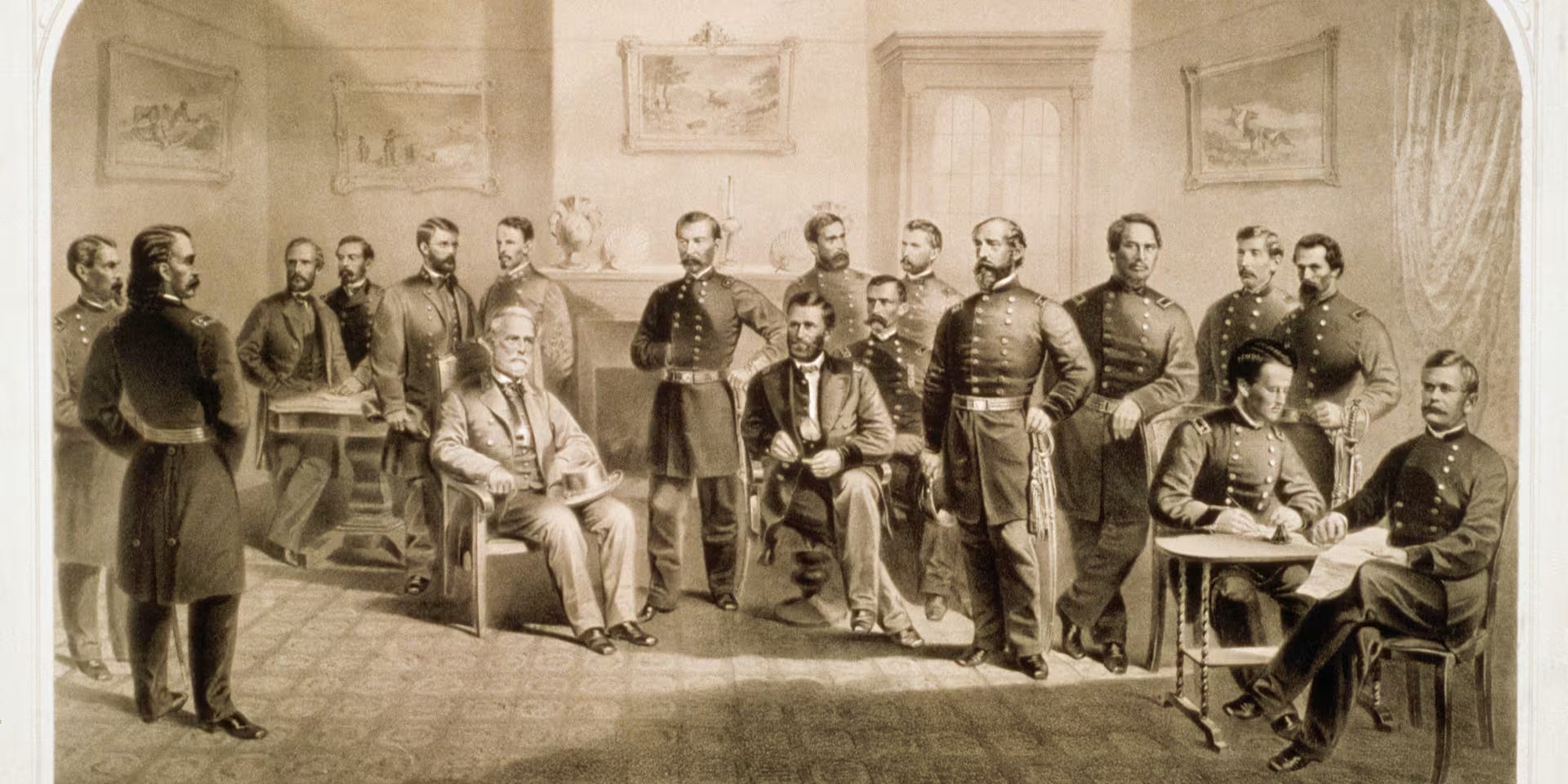
Grant’s terms were deliberately generous: Confederate soldiers would be paroled, officers could keep their sidearms, and men could take their horses home for spring planting. As Lee rode away, Grant ordered his men to stop celebrating, saying “The Confederates were now our countrymen, and we did not want to exult over their downfall”. The formal documents were transcribed by Ely Parker, a Seneca officer on Grant’s staff, who replied to Lee’s surprised observation about meeting “one real American” by saying simply: “Sir, we are all Americans”.
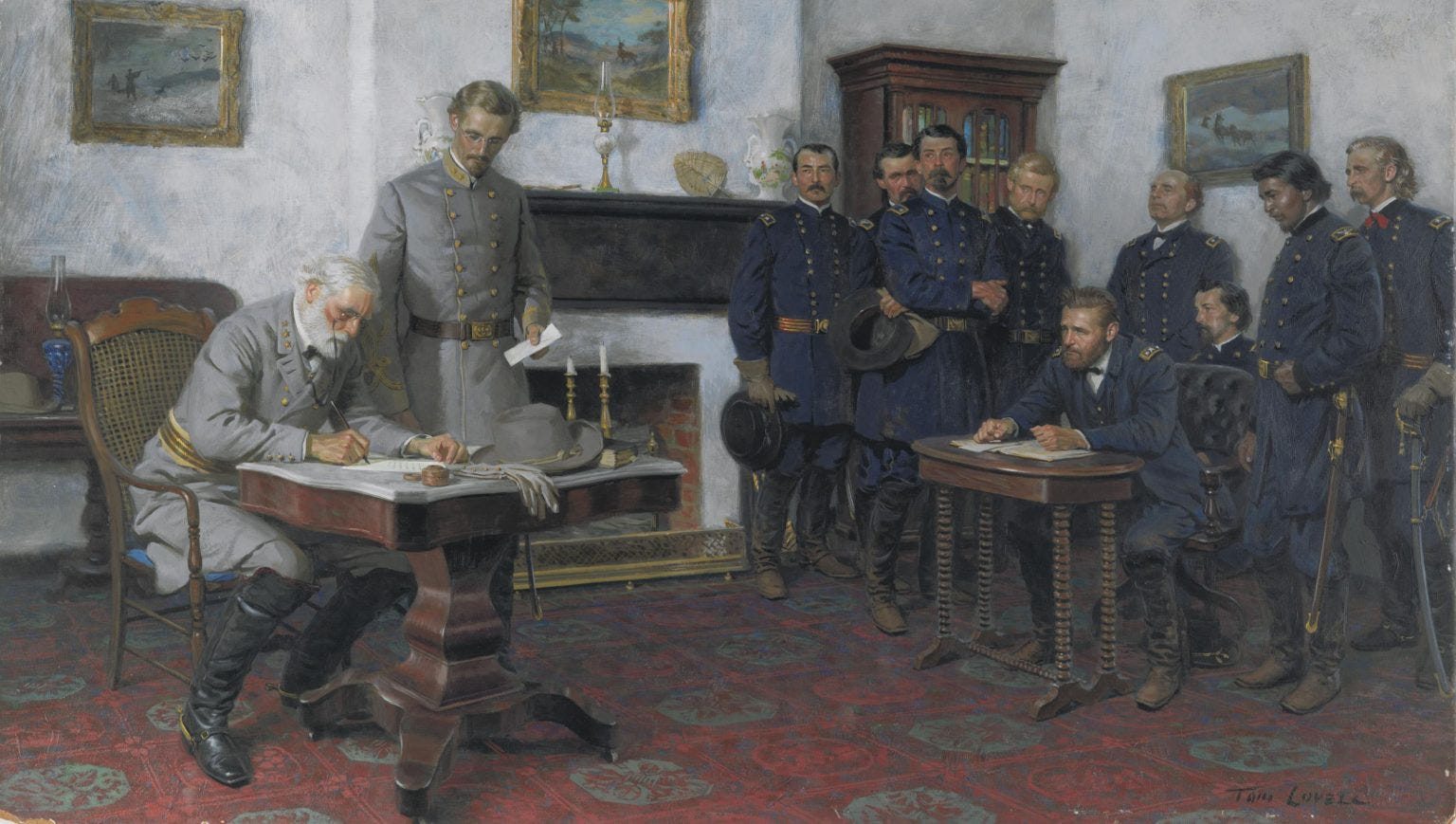
The surrender ended the bloodiest war in American history, but it also launched the long, unfinished argument about Reconstruction, racial equality, and what kind of nation the United States would become. The debates raging today over Confederate monuments, voting rights, and the meaning of American citizenship are direct descendants of the choices made in the days and weeks after Appomattox. Grant’s generosity was meant to speed reconciliation, but Lincoln’s assassination altered the course of reconstruction in ways we are still grappling with today — a reminder that how a nation chooses to end a conflict shapes the conflict’s aftermath for generations.
1917 — Canada Storms Vimy Ridge
On April 9, 1917 — Easter Monday — all four divisions of the Canadian Corps attacked Vimy Ridge together for the first time in the war, launching their assault at precisely 5:30 a.m. behind one of the most precisely timed artillery barrages in military history. The ridge, in northern France, had been held by Germany since 1914 and had repelled both French and British attacks at enormous cost. More than 15,000 Canadian infantry overran German positions along the entire front in a single morning, achieving in hours what Allied forces had failed to accomplish in years. The victory came at a cost of more than 10,600 Canadian casualties, including 3,598 killed.
Vimy Ridge is more than a battle — it is the moment Canada began to see itself as a nation rather than a colonial appendage of Britain. The success was built on meticulous planning, rehearsal, and troop-level intelligence sharing — tactics the Canadian Corps actually taught to French officers afterward. For modern military and political observers, Vimy is a case study in how preparation and unit cohesion can defeat entrenched opponents, and a reminder that nations are often forged not in parliaments but in the crucibles of shared sacrifice. Canada’s insistence on independent foreign policy to this day is rooted in moments like this one.
1939 — Marian Anderson Sings at the Lincoln Memorial
On April 9, 1939 — Easter Sunday — contralto Marian Anderson stood on the steps of the Lincoln Memorial in Washington, D.C., opened with “My Country, ‘Tis of Thee,” and sang to a crowd of 75,000 people of all races, with millions more listening by radio. She was there because the Daughters of the American Revolution had refused to let her perform at Constitution Hall solely because she was Black — a refusal so egregious that First Lady Eleanor Roosevelt resigned her DAR membership in protest and worked to arrange the outdoor concert at the Memorial instead. Anderson herself later wrote that she had become “whether I liked it or not, a symbol, representing my people”.
The concert was a direct prelude to the Civil Rights Movement, and it drew a direct line from Lincoln’s legacy to the struggle for racial equality that would culminate in the March on Washington twenty-four years later — where Martin Luther King Jr. would stand on those same steps. The episode is also a story about institutional gatekeeping and the power of cultural refusal: the DAR’s attempt to silence Anderson amplified her voice to a national audience it never could have reached from inside Constitution Hall. In every era, the effort to exclude a voice from the established hall creates an opportunity for that voice to claim the public square.
1942 — The Fall of Bataan and the Death March Begins
On April 9, 1942, after months of desperate resistance on the Bataan Peninsula of the Philippines — fighting under extreme heat, disease, and dwindling supplies — approximately 75,000 American and Filipino soldiers surrendered to Japanese forces in the largest surrender of American troops since the Civil War. What followed was one of the most documented war crimes of the Second World War: a forced march of more than 66 miles in brutal heat, during which prisoners were beaten, shot, bayoneted, and beheaded. Roughly 10,000 men died during the march itself — approximately 1,000 Americans and 9,000 Filipinos. Only 54,000 of the 76,000 prisoners reached Camp O’Donnell.
The Bataan Death March is remembered every year at White Sands Missile Range through a memorial march that draws veterans, active duty soldiers, and civilians. But its deeper legacy is the moral and legal architecture it helped build: the atrocities at Bataan were central to the Tokyo War Crimes Tribunals and helped establish the international norms governing the treatment of prisoners of war that remain in force today. The U.S.-Philippine alliance — strained and negotiated in every generation since — was forged in shared blood at Bataan, and it remains one of the most consequential strategic partnerships in the Indo-Pacific at a moment when China’s assertiveness in the South China Sea has never been more pointed.
2003 — Baghdad Falls; Saddam’s Statue Is Toppled
On April 9, 2003, just three weeks after the U.S.-led invasion of Iraq began, American forces entered central Baghdad and — before an assembled international press corps and a crowd of Iraqi civilians — used an M88 armored recovery vehicle to pull down a 39-foot bronze statue of Saddam Hussein in Firdos Square. The images were broadcast live around the world, deliberately evoking the fall of the Berlin Wall, and President George W. Bush’s administration presented the moment as the liberation of Iraq from a tyrannical regime. A Marine corporal momentarily draped an American flag over the statue’s head before it was replaced with an Iraqi flag — a small detail that captured the entire ambiguity of the moment.
The Fall of Baghdad on April 9, 2003 is now one of the most debated days in recent American military history. What was presented as an ending was actually a beginning — of insurgency, sectarian war, the rise of ISIS, and two decades of regional instability that continue to reshape the Middle East today.
The Iraq War’s legacy haunts every subsequent American debate about military intervention, from Syria to Iran to the question of how the United States ended its involvement in Afghanistan. The toppled statue endures as a symbol of the gap between the story a government tells about a war and the story that history eventually writes — a warning about the seduction of the iconic moment and the long, complicated aftermath it obscures.