

March 30
89/276


On This Day…
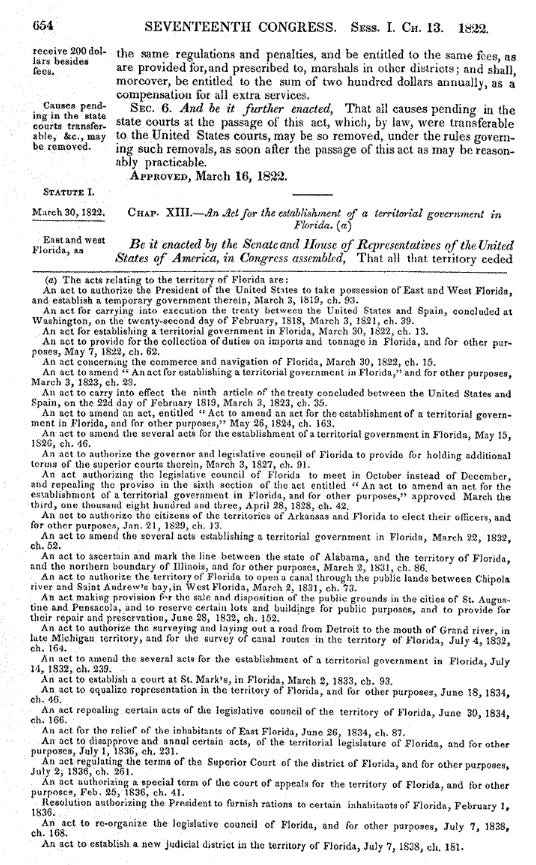
1822 – Florida Territory is organized by Congress
On March 30, 1822, Congress united East and West Florida into a single Florida Territory, formalizing what had been a murky, contested borderland between Spain, the United States, and various Native nations. The move followed the Adams–Onís Treaty, in which Spain ceded Florida to the United States amid imperial overstretch and pressure from U.S. military incursions under Andrew Jackson.
Territorial organization paved the way for the imposition of U.S. legal structures, the expansion of plantation slavery, and later statehood, while also setting the stage for the Seminole Wars and long‑term struggles over land and sovereignty. Lines drawn in Washington or on parchment quickly become lived realities on the ground, and that “administrative” decisions about territories and borders can lock in conflicts that resonate through today’s fights over immigration, voting rights, and federal power in places like Florida.
1856 – Treaty of Paris ends the Crimean War
On March 30, 1856, the Treaty of Paris formally ended the Crimean War between Russia and an alliance of the Ottoman Empire, Britain, France, and Sardinia, after years of brutal fighting that previewed the trench warfare and logistical nightmares of the twentieth century. The treaty neutralized the Black Sea, barred Russia from maintaining a navy or fortifications there, and was hailed as a triumph of collective European diplomacy restraining a great power.
Yet the settlement left many of the underlying tensions unresolved, sowing resentment in Russia and setting patterns of intervention and “balance of power” rhetoric that still echo in debates over NATO expansion, the Black Sea, and the war in Ukraine. Peace agreements that humiliate rather than reintegrate defeated powers often buy time rather than stability, and that the language of collective security can mask fragile bargains.
1867 – United States purchases Alaska from Russia
The Alaska Purchase saw U.S. Secretary of State William H. Seward agree to buy Alaska from the Russian Empire for $7.2 million, around two cents an acre, in a move widely mocked at the time as “Seward’s Folly.” Critics in Congress and the press saw the territory as a remote, icy wasteland with little strategic or economic value, and the deal became shorthand for government overreach and elite miscalculation.
Over time, Alaska’s vast reserves of oil, gas, minerals, timber, and fisheries turned the “folly” into one of the most lucrative territorial acquisitions in U.S. history, while its location made it a strategic buffer with Russia during the Cold War and a key theater for today’s Arctic geopolitics. The episode is a reminder that democratic skepticism can coexist with long‑term strategic vision, and that policies derided in the short term can fundamentally reshape national power and climate‑era politics generations later.
1959 – The Dalai Lama flees Tibet for India
On March 30, 1959, the 14th Dalai Lama crossed into India after a failed uprising in Lhasa against Chinese rule, beginning a life in exile that would turn Tibet’s struggle into a global cause. India granted asylum, and Dharamsala became the seat of a government‑in‑exile that fused Buddhist spiritual authority with a modern vocabulary of human rights and nonviolent resistance.
The Dalai Lama’s international visibility complicated Sino‑Indian relations, influenced diaspora politics, and helped shape global expectations about religious leaders as moral critics of authoritarianism, even as Beijing tightened control over Tibet and sought to manage succession on its own terms. Exile can amplify a movement’s moral power even as it loses territorial control, and that border decisions in one crisis can reverberate through regional security architecture for decades.
1962 – U.S. claims Castro sent cocaine to Florida to “demoralize” Americans

On March 30, 1962, federal officials alleged that Fidel Castro’s Cuba was sending cocaine into Florida with the explicit aim of “demoralizing” the United States, blending Cold War anti‑communism with the emerging politics of narcotics and moral panic. Framed as another front in the struggle against Havana after the Bay of Pigs and amid rising tensions that would culminate in the Cuban Missile Crisis, the claim portrayed South Florida not just as a geographic neighbor but as a frontline in ideological and social warfare.
Whether or not the intelligence was as clear as the rhetoric implied, the episode helped cement Florida’s place in the national imagination as a porous, contested gateway where foreign enemies, drugs, and subversion converged, prefiguring the later “war on drugs” and Miami’s role in it. When Washington casts criminality as an extension of geopolitics, it often blurs the line between law enforcement and foreign policy in ways that amplify fear, justify aggressive policing, and leave long scars on border communities like those in Florida.
1979 – Assassination of Airey Neave at Westminster
British MP Airey Neave, a close adviser to Conservative leader Margaret Thatcher and a former war hero who had escaped from Colditz, was killed on March 30, 1979, when a car bomb exploded as he drove out of the Palace of Westminster. The Irish National Liberation Army claimed responsibility, marking one of the most audacious attacks of the Troubles and driving home that mainland Britain itself was not insulated from the conflict in Northern Ireland.
The killing hardened security attitudes in London, influenced Thatcher’s early approach to Irish policy, and helped normalize counterterrorism measures and surveillance practices later adapted to jihadist threats. Targeted political violence can have outsized impact far beyond its immediate casualties, forcing democracies to balance civil liberties against security in ways that echo through future crises.
1981 – President Ronald Reagan is shot outside the Washington Hilton, D.C.
On March 30, 1981, President Ronald Reagan was leaving the Washington Hilton when John Hinckley Jr. opened fire, striking Reagan, Press Secretary James Brady, a Secret Service agent, and a D.C. police officer in a burst of chaos captured by cameras and replayed nationwide. The shooting turned a mid‑afternoon routine appearance into a constitutional stress test: for hours, questions swirled about Reagan’s condition, the chain of command, and how the White House would project calm to allies and adversaries alike.
Reagan’s survival and carefully staged recovery—quips with surgeons, images of strength—helped cement his public image, while Brady’s grievous injuries eventually fueled the movement that produced the Brady Handgun Violence Prevention Act, entwining D.C.’s geography with the modern gun‑control debate. The shooting was a good reminder that moments of vulnerability in the capital can harden into political myth and policy architecture, and that the choreography of crisis response in Washington often matters as much as the incident itself in shaping public memory and future law.